
Temperature ratings, explained
Every VBX Bunny Boot carries three temperatures. The Ankle Deck Boot VBX carries a single rating, -35°F. The Bunny Boot ratings come from a lab measurement of insulation, converted by the manufacturer into a guide. Here is what each number means, how it's made, and what it can't tell you.
| Rating | Meaning | Use it when |
|---|---|---|
| Comfort | All-day warmth | You'll stand or sit still for long periods, such as on the ice or on watch |
| Capable | Warm enough for work or time outside | You'll be moving and generating heat most of the time |
| Max | The coldest the boot is built for: minutes, not hours | Brief exposure only. Treat it as a limit |
| Model | Comfort | Capable | Max | Measured insulation |
|---|---|---|---|---|
| VBX MAX | -34°F | -57°F | -79°F | 2.14 clo |
| VBX COMPOSITE | -31°F | -53°F | -76°F | 2.01 clo |
| VBX NEO | -27°F | -50°F | -72°F | 1.88 clo |
| VBX LITE | -5°F | -28°F | -45°F | 1.36 clo |
| Ankle Deck Boot VBX | Rated to -35°F (single rating) | Not published | ||

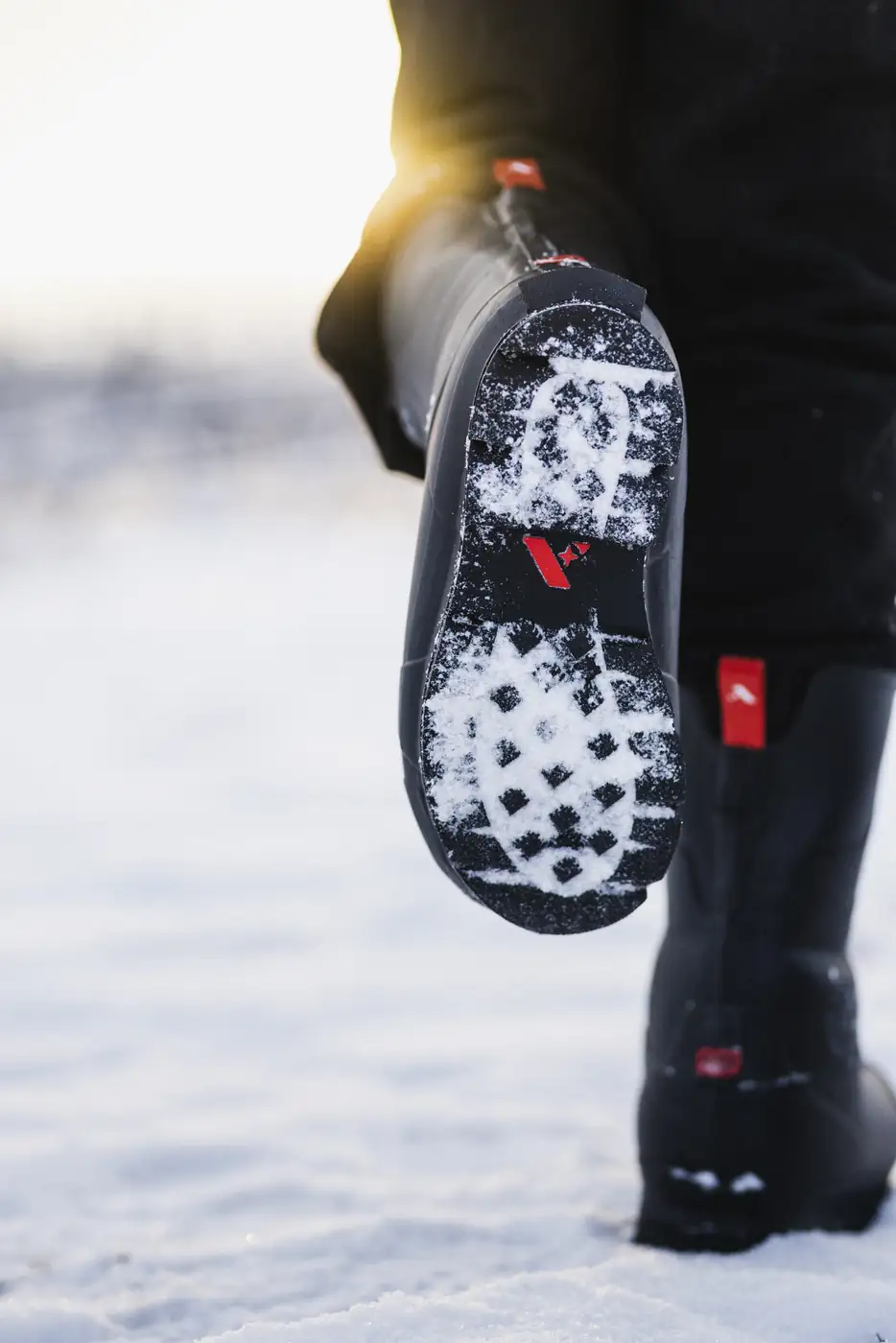
How the ratings are made
- Lab measurement. Each boot's insulation is measured at North Carolina State University's Wilson College of Textiles, Textile Protection and Comfort Center.
- Method. ASTM F3426, using a heated foot form divided into nine sections, each with its own heater and sensor.
- Conditions. Foot held at 95°F, chamber at 41°F and humid, a light breeze across the toes, the boot worn over a merino-wool blend sock.
- Repeats. Three tests per boot, averaged into one clo value.
- Conversion. The manufacturer, not the lab, converts the clo value into Comfort, Capable, and Max temperatures. The system is called ArClo.
The manufacturer states that the ratings are a guide and do not guarantee against frostbite or cold injury.
What clo means
Clo is a unit of thermal insulation. One clo equals 0.155 m²·K/W, roughly the insulation that keeps a resting person comfortable at about 70°F in ordinary clothes. Higher clo means more insulation. It is the closest thing footwear has to a common measure of warmth.
The Army's 2023 specification for its extreme cold boot, rated to -60°F, requires at least 1.5 clo overall. VBX NEO, COMPOSITE, and MAX all report higher values; VBX LITE reports lower. The Army measures on its own heated foot at 59°F or lower, so the numbers are close in kind but not directly comparable.
What no rating can tell you
No standard converts footwear clo into temperature ratings. Kansas State University's Institute for Environmental Research, which runs the same ASTM test, says it does not calculate footwear temperature ratings for ethical reasons. Every boot's temperature rating, from every brand, is the maker's own judgment.
Clo measures dry insulation. The point of a vapor barrier boot is that its insulation stays dry, so the measured value should hold when the foot sweats or the boot is soaked. That has been shown for military vapor barrier boots, which lost 5 to 6 percent after 18 hours in water. No independent wet test of VBX boots has been published.
What changes how warm you feel
Two people in the same boot at the same temperature can have very different days. The biggest factors:
- Activity. Moving generates heat. Standing still does not. This is why Comfort and Capable differ by more than 20 degrees.
- The rest of your clothing. When the body loses heat, it cuts blood flow to the feet first to protect the core. Cold feet are often a sign of an underdressed body.
- Socks and fit. A tight boot or extra sock that squeezes the foot cuts circulation and makes feet colder.
- Wind and wet. Sweating, walking, and wind together reduced footwear insulation by about 45 percent in lab tests on conventional boots.
- Individual circulation. Some people run cold. Leave margin.
Try it on the cold scale
- VBX MAX-34° / -57° / -79°F
- VBX COMPOSITE-31° / -53° / -76°F
- VBX NEO-27° / -50° / -72°F
- VBX LITE-5° / -28° / -45°F
- Ankle Deck Boot VBXRated to -35°F