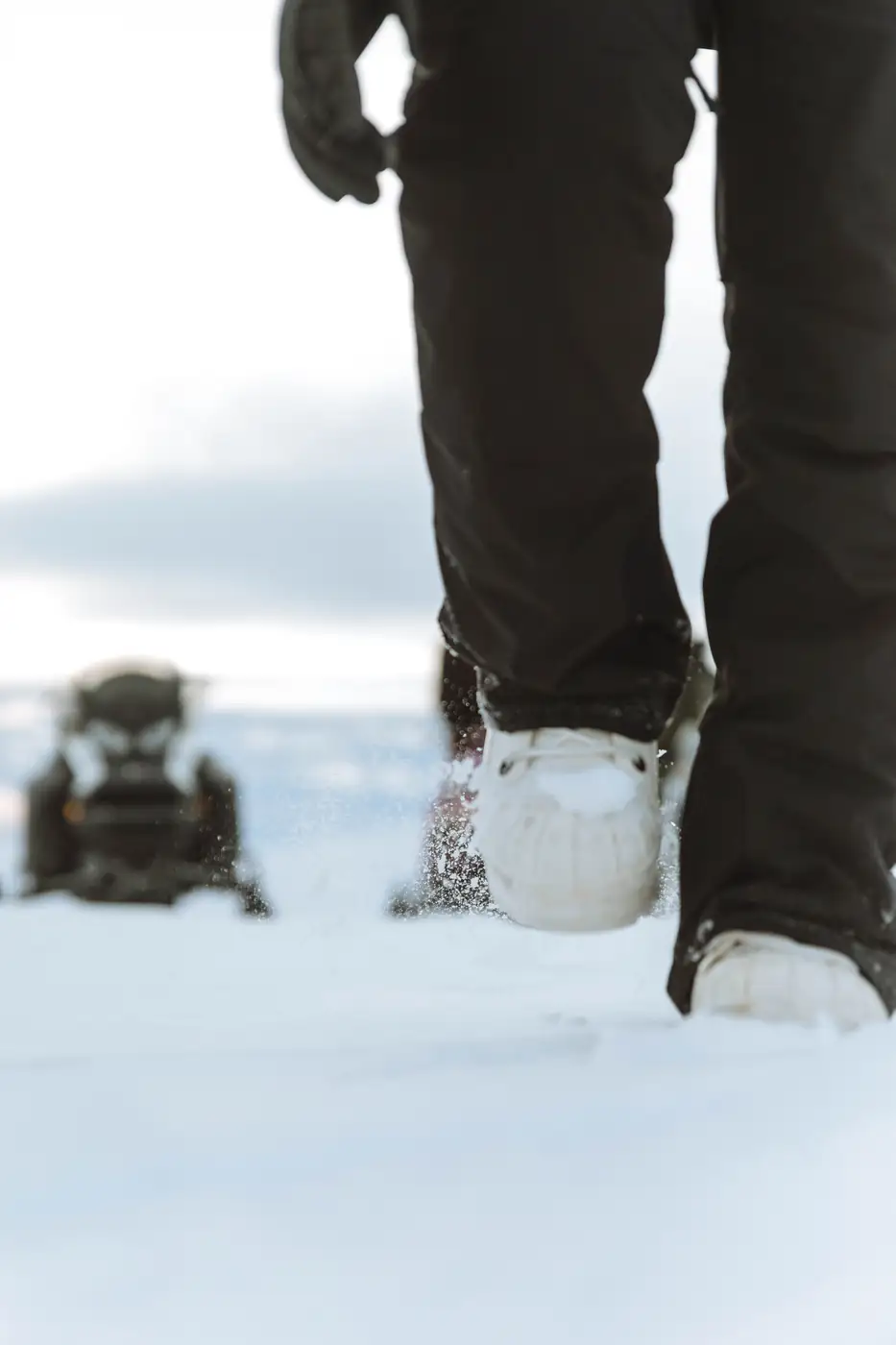
How vapor barrier insulation works
A vapor barrier boot seals its insulation between two waterproof, vapor-tight layers. The outer layer keeps out environmental water and the inner layer keeps out sweat, so the insulation stays dry and keeps its full value no matter how wet the foot or the ground gets.
How a foot loses heat
Four paths, and water speeds up all of them.
Insulation keeps a foot warm by trapping still air, which conducts heat poorly. Water conducts heat about 26 times better than air, and ice about 96 times better. Evaporating sweat carries heat away on top of that. Moisture trapped in a material can double its thermal conductivity.
| Path | What it is | Where it matters in a boot |
|---|---|---|
| Conduction | Heat moving through material in contact. Faster with more conductive material, more contact, and a bigger temperature difference. | Through the boot wall, and through the sole into ice, snow, or frozen ground. Wet socks and wet insulation conduct far more heat than dry ones. |
| Convection | Moving air or water carrying heat away. | Air pumped in and out of a boot while walking. Wind across the boot. |
| Evaporation | Liquid turning to vapor absorbs 2,256 kJ per kilogram of water. | Sweat evaporating from the sock and skin. Each gram removes about 2.26 kJ from the foot. |
| Radiation | Infrared energy given off by warm surfaces. | Present, but the boot wall blocks the direct path to cold surroundings. |
The Army's 2023 specification for its extreme cold boot requires more insulation under the foot than over it: at least 2.8 clo at the sole, against 1.7 at the toe and 1.8 at the heel. The likely reason is conduction. Under body weight, the sole is pressed hard against the coldest surface the foot touches.
Sweat is the water you can't keep out
Every boot has a moisture source inside it.
Harbor workers in winter built up an average of 20 g of sweat per foot per day in their footwear. Workers on high masts averaged 37 g, ranging from 6 to 94 g.
Kuklane and Holmér 2000; Kuklane, Gavhed, and Holmér 2000On a sweating thermal foot, sweat rates of 3, 5, and 10 g per hour cut footwear insulation by 9 to 19, 13 to 27, and 19 to 36 percent. Warmer, thicker boots lost a larger share.
Kuklane, Holmér, and Giesbrecht 1999Sweating, walking, and wind together reduced footwear insulation by about 45 percent.
Kuklane 1999Sweat built up during exercise keeps evaporating and cooling the feet after the wearer stops moving.
Natick TR 68-32-CM
Why ordinary boots get colder as the day goes on
Paul Siple, the Army's cold weather clothing adviser, described a conventional cold weather boot as a closed-circuit refrigeration system. Water vapor from the foot moves outward, reaches the cold outer shell, and condenses there, giving up heat taken from the body. The liquid soaks back toward the foot, where body heat evaporates it again. Every cycle moves more heat out of the foot. A single-layer boot can't stop the cycle. The vapor barrier boot was invented to break it.
Why breathable boots struggle below freezing
A breathable boot stays dry only if sweat vapor crosses the whole boot wall and leaves. Cold stops that from happening.
- Breathability is a heat-loss path. Vapor leaving through a membrane carries its latent heat with it. In subfreezing air, where humidity is near zero, that evaporation runs fast and takes a lot of heat. SATRA
- Cold air carries less moisture. As temperature drops, vapor moves through clothing less efficiently and is absorbed by the insulation instead, lowering its value. Meinander and Hellsten 2004
- Vapor condenses where the wall gets cold. Temperature falls from skin temperature at the foot to air temperature at the shell. Vapor condenses or freezes where it meets cold material, forming frost inside the boot that chills the feet again as it melts. Natick TR 68-32-CM
- The outer layers collect the most ice. On a sweating thermal manikin in cold-protective clothing rated 0 to -50°C, accumulated water rose with sweat rate and with falling temperature, and the largest amount was always in the outer layer. Only 12 to 60 percent of sweat evaporated out. Meinander and Hellsten 2004
- Membranes didn't change the result. The same study found no systematic difference in moisture or heat loss between clothing with and without a waterproof-breathable membrane. That study tested clothing; the same physics applies to a boot wall. Meinander and Hellsten 2004
- Breathability ratings are measured warm. Standard breathability tests run at skin temperature or room temperature with no condensation. None represents a boot at -20°F. Meinander and Hellsten 2004; SATRA
Breathable insulated boots are a reasonable choice for active use in moderate cold, where vapor can still escape and the boot can be dried every night. In sustained subfreezing cold, in standing water, or when hard work alternates with long periods of standing still, they depend on the moisture transport that cold shuts down.
The Army's head-to-head test
In 1990 the U.S. Army Research Institute of Environmental Medicine tested five boots on a thermal foot model, dry and after 18 hours standing in 10 cm (about 4 inches) of water, then on seated volunteers at -10°F.
| Boot | Construction | Insulation lost, overall | At the toes | Water gained per pair | Time seated at -10°F |
|---|---|---|---|---|---|
| Standard Army cold-wet vapor barrier boot | All rubber, wool-felt insulation | 5% | 10% | 26 g | 125 min |
| Modified vapor barrier boot | All rubber, synthetic insulation | 6% | 15% | 42 g | 124 min |
| Commercial leather boot A | Waterproof-breathable membrane, synthetic insulation | 27% | 35% | 196 g | 64 min |
| Commercial leather boot B | Waterproof-breathable membrane, synthetic insulation | 35% | 42% | 444 g | 81 min |
| Multi-component system | Leather boot over a separate breathable sock | 13% | 22% | 147 g | 73 min |
Both vapor barrier boots were dry inside after immersion. Both membrane boots let in standing water. The Army concluded that only vapor barrier footwear gave adequate protection in the simulated cold-wet conditions.
It still didn't adopt the vapor barrier boot for milder cold-wet duty. Its reasons were weight, awkwardness, heavy sweating during exercise, skin maceration without strict foot hygiene, and fast insulation loss if the rubber is punctured. For temperatures between 14 and 68°F the Army instead developed a breathable boot with a removable insulation bootee that soldiers swap when wet.
Inside a vapor barrier wall
From the foot outward, the military design has four parts:
- Sock. One pair of wool cushion-sole socks in Army use.
- Inner lining and inner rubber barrier. Keeps sweat out of the insulation.
- Insulation. Historically two layers of deep-pile wool fleece facing each other with an air chamber between them.
- Outer rubber barrier. Keeps outside water out of the insulation.
Source: Natick TR 68-32-CM.
Where the sweat goes
Sweat stays on the foot side of the inner barrier. It can't reach the insulation, so it can't reduce the insulation. Because it can't evaporate outward either, the cooling cycle Siple described stops. Feet stay warm even though they sit in a saturated atmosphere, which overturned the old rule that dry feet mean warm feet.
Army and Surgeon General studies in the early 1950s found the inner rubber barrier physiologically safe. It reduced total sweat buildup. Once the sock saturated, extra moisture was reabsorbed into the skin and a new equilibrium held. A Navy and Army study found no increase in athlete's foot. Wrinkled skin from long wear clears when feet are dried and socks are changed.
When water comes over the top
If you step into overflow or slush deeper than the boot, the inner barrier holds the water next to the foot, where body heat warms it quickly. The Army judged this safer than the shoepac it replaced, whose many sock layers each got wringing wet. The current Army tag puts it simply: if ice water spills into the boot, it warms to body temperature rapidly.
The sealed insulation is still dry. Pour out the water, put on a dry sock, and the boot keeps its full insulation.
How VBX boots are built
VBX, for Vapor Barrier X, is the name for the sealed system used across the current lineup. Construction details below are manufacturer specifications.
- Outer shell
- 100% waterproof vulcanized rubber
- Inner barrier
- Waterproof vulcanized rubber lining
- Insulation
- Felted wool, fully encapsulated between the rubber layers
- Liner fabric
- 90% polyester, 10% spandex
- Collar
- Insulated vulcanized rubber gusset on VBX MAX, LITE, and COMPOSITE; flexible neoprene gusseted collar on VBX NEO and the Ankle Deck Boot VBX
- Footbed
- High-rebound EVA drop-in midsole, perforated with the sockliner to reduce moisture buildup underfoot; half-size insert on Bunny Boot models
- Outsole
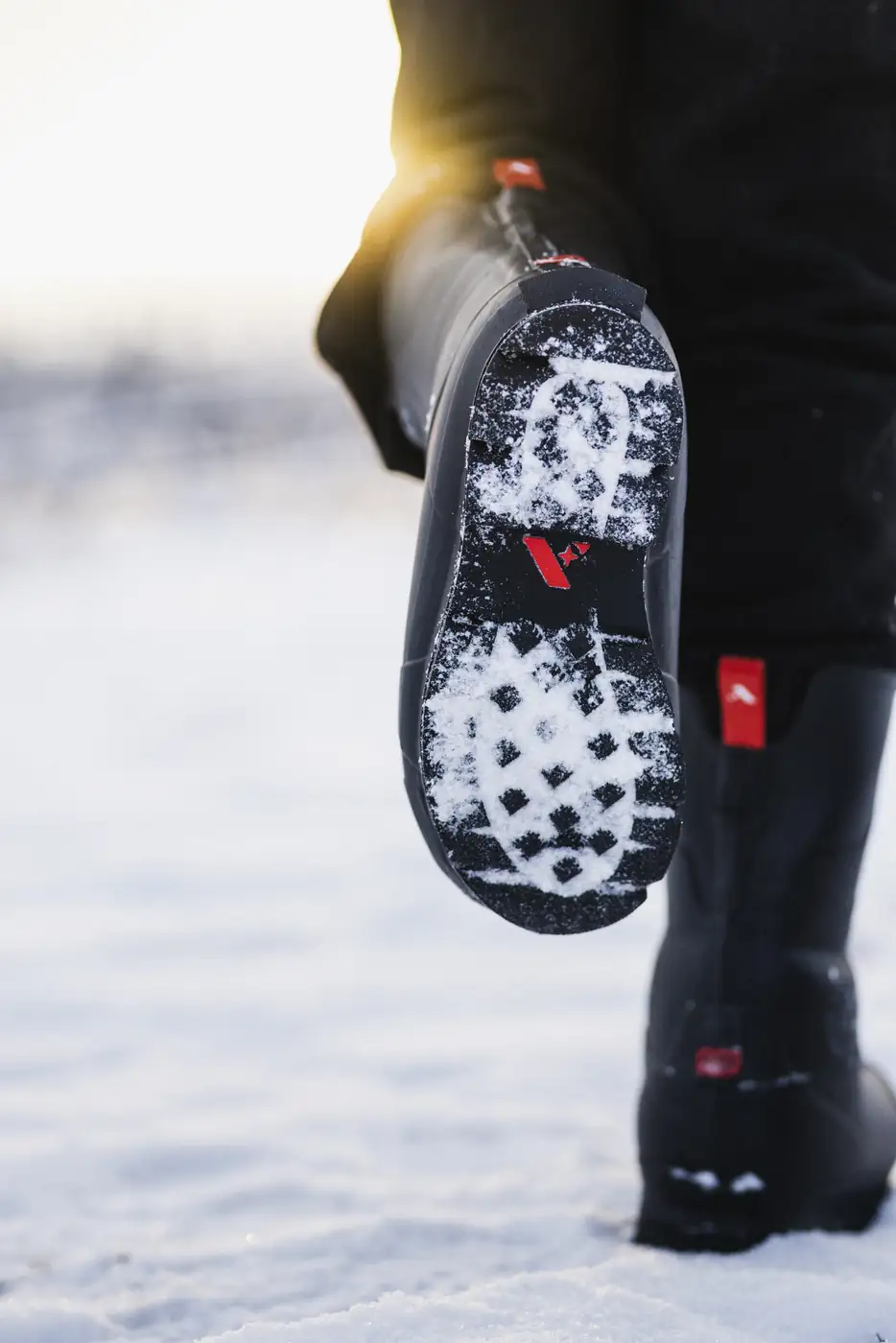
- Rubber with deep diamond-shaped lugs on Bunny Boot models; non-marking siped rubber on the deck boot
- Air valve
- None
The layer order follows the military double vapor barrier: rubber, sealed insulation, rubber. The 1950s boot used wool fleece around an air chamber. VBX uses felted wool, a dense matted sheet. Whether the VBX wall keeps a distinct air chamber like the original has not been published.
Why there's no air valve
The military valve exists for airborne troops, whose boots pinch at altitude as trapped air expands, and for leak testing at the factory. Most civilians need neither. Alaska Gear Company's design removed the valve, calling it a key point of failure in the older boots, and relies on the rubber seal alone.
The tradeoffs
Vapor barrier boots trade weight, bulk, and sweaty feet for insulation that water can't defeat. The costs are documented as clearly as the benefits.
| Tradeoff | What the evidence shows |
|---|---|
| Weight | VBX MAX weighs about 8 lb per pair in sizes 9 to 12. The Army white boot may weigh up to 7.25 lb per pair in size 9. |
| Sweat and skin | Feet sweat heavily during exercise. Without regular sock changes and foot drying, the risk of skin maceration rises. |
| Warm in mild weather | The Army noted excessive warmth above 40°F. Its tag says to wear the white boot when temperatures of -14°F or below may occur. Marine Corps officials have said the extreme cold boot can make feet sweat excessively above -20°F. |
| Punctures | A hole in the rubber lets moisture reach the insulation, which then loses value quickly. Patching works in most cases. |
| Not a guarantee | No boot prevents frozen feet in subzero weather if the wearer stays motionless for hours. |